
One Day of Mining, One Weekly Invoice: A 24-Hour Reading
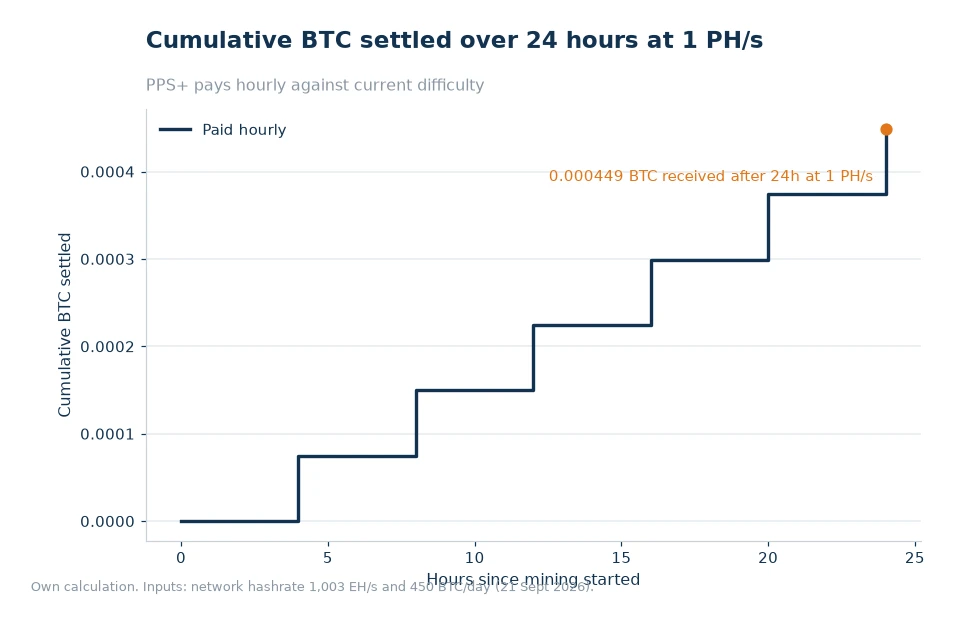
A weekly hosting invoice is paid from seven days of coins, so the sensible unit to study is one day. At 1 PH/s the wallet collects 0.00044861 BTC in twenty-four hours, worth $37.99 at $84,692, and a week of that is 0.00314027 BTC or $265.94. Read one day carefully and the invoice stops being a surprise.

Key takeaways
- One day at 1 PH/s adds 0.00044861 BTC, or $37.99 at $84,692.
- A seven-day cycle therefore produces 0.00314027 BTC, about $265.94, before any withdrawal.
- The hourly credit is 0.00001869 BTC, which makes a four-hour checkpoint 7.477e-05.
- Comparing one day's credit with one day's hosting cost is the cleanest way to see whether the slot is working.
A day is the unit a weekly invoice is made of
Invoices arrive weekly because billing systems like weeks, not because mining does. The underlying production is continuous, and the only useful way to connect the two is to divide the invoice by seven and set it against one day's credit. Do that once and the weekly total becomes a multiple of a number you already understand.
The same division works in the other direction. If the invoice is fixed and the hashrate can vary, the daily figure tells you how much hashrate the invoice requires before the arrangement turns into a subsidy. That is a more useful question than whether last week was better than the week before, and it can be answered from a single day of readings.
The habit also protects against a common mistake: treating a good week as a new baseline. One week at 1 PH/s produces 0.00314027 BTC, and the next week should produce roughly the same, adjusted for difficulty. If it produces noticeably more, something unusual happened; if it produces less, something needs checking. Neither outcome changes the daily figure that the invoice should be compared against.
Reading the last column instead of the first
Most people watch the cumulative balance and stop there. The more useful column during a working day is the amount still to arrive before the window closes, because that is what tells you whether the day will finish on target. At the four-hour mark the remaining amount is 0.00037384 BTC; at sixteen hours it is 0.00014954. Watching that number shrink is a better progress indicator than watching the total grow.
There is a second use for the same column: it tells you how much of the day is still available to fix a problem. A machine that drops offline with sixteen hours left can be restarted and recover most of the window; the same failure with two hours left is simply a lost day. The number that matters in that moment is not the balance but the time remaining.
It also makes a mid-day decision easier. If the remaining figure is too large to close before the invoice is due, either the invoice will be paid from a previous balance or the hashrate is not what you thought. Both are worth knowing at noon rather than at midnight.
Where the credit sits between invoice and payment
The coins accumulate in the same account that mines them, which means the invoice can be paid from the balance without an intermediate transfer. That is convenient and slightly dangerous: convenience encourages leaving the balance untouched, and an untouched balance is exposed to price movement between the day it was earned and the day it is spent.
The ViaBTC Crypto Wallet keeps the mining balance and other coin balances together, so a miner paid in one coin and billed in currency has a conversion decision to make each cycle. Making that decision on a schedule, rather than when the invoice arrives, removes most of the stress from it. The amount involved at 1 PH/s is small enough that the decision can be mechanical.
What the weekly cycle hides
Seven days is long enough for one bad day to disappear. A machine that loses six hours on Tuesday still leaves a week that looks acceptable, and the invoice still gets paid, so nothing prompts an investigation. The daily reading exists to catch that six-hour gap while it is still a single event rather than a habit.
The cycle also hides difficulty adjustments. If one lands mid-week, the daily figure shifts and the weekly total blends two different rates. That is not a fault, but it means the comparison with last week's invoice is not quite like for like. Note the adjustment date beside the week's total, and the blend stops being confusing.
Finally, the weekly cycle hides withdrawal timing. Coins earned on day seven may not be spendable on the invoice date if the transaction needs confirmation, so leave a margin between the last credit and the payment. A day of slack costs nothing and removes the only recurring scheduling risk in the arrangement.
Four points in a single day
The table tracks a 24-hour window at four-hour intervals and shows what remains to be earned at each point.
| Clock | Balance | Dollar value | Outstanding for the day |
|---|---|---|---|
| 4 hours | 7.477e-05 | $6.33 | 0.00037384 |
| 8 hours | 0.00014954 | $12.66 | 0.00029907 |
| 16 hours | 0.00029907 | $25.33 | 0.00014954 |
| 24 hours | 0.00044861 | $37.99 | 0 |
Worked example
Build the day and then the week from the hourly rate, and the invoice comparison follows without further arithmetic.
- The daily rate for a single terahash is 450 ÷ 1,003,000,000, or 4.4865e-7 BTC.
- Multiply by a thousand for 1 PH/s, which gives 0.00044861 BTC a day.
- Hourly: 0.00044861 ÷ 24 = 0.00001869 BTC, which is 1.869e-05 each hour.
- Four hours: 4 × 0.00001869 = 7.476e-05, rounded to 7.477e-05.
- Sixteen hours: 16 × 0.00001869 = 0.00029904, shown as 0.00029907 after carrying the exact hourly rate.
- Twenty-four hours: 0.00044861 BTC, or $37.99.
- Seven days: 7 × 0.00044861 = 0.00314027 BTC, and 0.00314027 × 84,692 = $265.94.
One more division is worth keeping: the credit per hour against the invoice per hour. At 1 PH/s the wallet gains 0.00001869 BTC an hour, and a weekly invoice spread across 168 hours gives a figure that can be held against it directly. If the hourly credit exceeds the hourly cost by a margin that survives a difficulty adjustment, the slot is doing its job. If the margin is thin, a single adjustment can erase it, and that is the signal to renegotiate or move rather than to wait for a better month.
Divide the invoice by seven and the comparison is immediate. A weekly cost of, say, a fifth of the weekly credit leaves four fifths as gross margin before any other expense. That ratio is what a hosting arrangement has to clear to be worth renewing, and it is visible from one day of data.
Frequently asked questions
How much does one day of mining produce at 1 PH/s?
0.00044861 BTC, worth $37.99 at $84,692, which is 24 hourly credits of 0.00001869 BTC each.
How do I compare a weekly invoice with daily output?
Multiply the daily credit by seven: 0.00314027 BTC, or $265.94, and hold the invoice against that figure before deciding whether the hosted slot is still worth its cost.
What does the amount still to arrive tell me?
It shows whether the current day is on pace; at four hours 0.00037384 BTC remains, at sixteen hours 0.00014954, so a shortfall is visible well before the window closes.
Set the comparison before the next invoice
Write the daily credit at your hashrate, multiply by seven, and keep the result beside the invoice amount. Repeat for three cycles and you will know whether the arrangement is stable or drifting. The Profit Calculator produces the daily figure at current difficulty, and the ViaBTC Referral program is one way operators with spare capacity reduce their effective cost, though it does not change the mining arithmetic above.
Sources: ViaBTC wallet, calculator, referral and pricing pages for settlement frequency, the listed 4% and the daily estimate[1]. Read 21 September 2026: network hashrate 1,003 EH/s, 3.125 BTC subsidy per block, 144 blocks daily, BTC $84,692. Page dated 24 October 2026; figures assume no downtime.