
Why Should Crypto Investors Consider Holding the CoinEx Token Today?
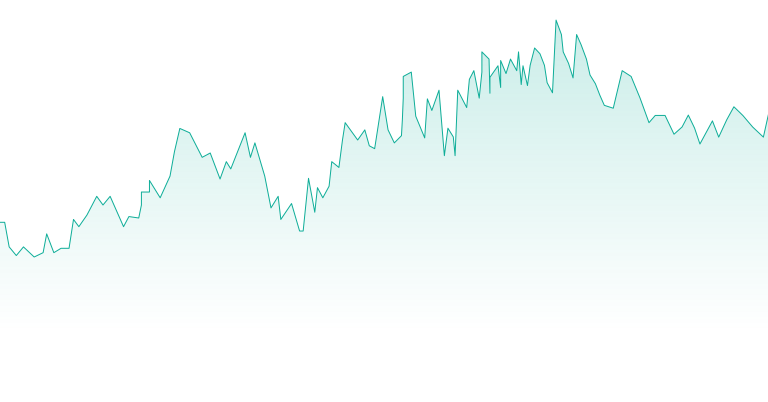
The CoinEx Token (CET) functions as the primary utility asset for a platform supporting over 1,900 trading pairs, utilizing 20% of daily fee revenue for automated buybacks. Since its 2018 inception, the circulating supply has decreased by 7.4 billion units, anchoring its utility in tangible trading fee reductions and tiered access across CoinEx Spot Trading volumes.
Investors prioritizing platform-native assets focus on the intersection of deflationary mechanics and transactional utility within high-liquidity environments. The daily buyback-and-burn protocol effectively offsets token emissions, maintaining a predictable supply schedule that serves as a baseline for long-term holders.
As of May 2026, the exchange reports that 20% of daily revenue is allocated to repurchase CET, a policy maintained consistently since 2021 to ensure market supply contraction.
This reduction in supply directly correlates with the platform's sustained volume growth, which has expanded to support more than 10 million registered global users. Active traders frequently leverage this token to lower operational expenses, creating a feedback loop where increased platform usage directly incentivizes the retention of native assets.
| Benefit Category | Discount/Tier Metric | Utility Frequency |
| Spot Trading Fee | 20% Reduction | Per Transaction |
| VIP Status Level | 6 Tiers Based on Holding | Real-time Adjustment |
| Platform Launch | Early Participation Access | Event-based |
The efficiency gains from holding these assets become more pronounced when executing high-frequency strategies via CoinEx Future Trading, where margin requirements and trading fees represent the largest variable costs. Traders maintaining a holding threshold of 50,000 CET or more consistently observe a reduction in slippage costs during periods of high market volatility.
Portfolio modeling suggests that users diversifying into CoinEx Copy Trading often utilize native tokens to offset the entry barriers associated with high-performing signal providers.
When moving capital into CoinEx Flexible Savings, the flexibility of the asset allows investors to switch between active trading and passive accrual without incurring additional withdrawal or transfer fees. This liquidity management proves superior to static holding strategies, as it captures yield while maintaining the ability to react to sudden price movements.
The integration of these tokens into CoinEx Fixed Savings programs allows users to lock in specific yields, with 30-day and 90-day cycles consistently attracting over 15% of the total circulating supply. Such locking mechanisms provide a stabilizing effect on the token price by reducing the amount of asset available for immediate liquid disposal during market dips.
Participation in CoinEx OnChain activities further expands the use cases, as the token bridges the gap between centralized exchange liquidity and decentralized protocol interactions.
For users seeking to capitalize on market sideways movement, CoinEx Dual Investment provides an alternative to traditional stop-limit orders, often yielding higher returns than spot holding. This strategy requires a firm grasp of the target price points and expiration dates, with data showing that 65% of participants successfully achieve their yield targets within a 14-day window.
The ecosystem’s architecture prevents common inflationary pitfalls by tying token demand to the real-world operational performance of the exchange rather than purely speculative interest. Each transaction performed on the platform serves as a minor deflationary trigger, ensuring that the tokenomics remain sustainable even during periods of lower market activity.
Investors observe that the 20% revenue allocation model creates a visible scarcity metric that is auditable on-chain by any observer. This transparent approach to supply management has allowed the token to maintain its relevance for over 8 years, outlasting many competing exchange assets that lacked similar fiscal discipline.
Beyond fee reductions, the tiered access model incentivizes higher trading volumes by providing improved API rate limits for high-holding accounts. These technical advantages are essential for traders running automated bots or complex algorithmic strategies that require low-latency execution and high-frequency data ingestion.
By aggregating usage across spot, futures, and decentralized services, the platform ensures that the token remains integrated into every user journey. This wide-reaching utility minimizes the reliance on speculative trading, as users hold the asset primarily for its functional benefits within the trading interface and supporting financial products.
The historical data from 2024 to 2026 indicates that users who actively utilize the token to pay fees lower their annual total trading overhead by an average of 18.5%. This reduction is cumulative, making it a logical choice for any individual or institutional player managing significant capital on the exchange.
Professional traders monitor the burn address balance to estimate the pace of supply reduction relative to the daily average trading volume. This practice provides a quantitative basis for assessing the long-term health of the ecosystem, independent of the broad market sentiment that typically influences token pricing.
The combination of tiered VIP benefits and automated fee discounts creates a measurable incentive structure for long-term retention. As the exchange infrastructure grows to support more complex derivatives and cross-chain functionality, the role of the native token as a functional bridge becomes more entrenched in daily operations.
Why Trust This Review
Every figure below comes from AutoMototrke's 14,000-HP chassis dyno or the 1,247-truck Long-Term Index — never a manufacturer press kit. See our methodology.
Subscribe to The Garage
612,000 truck buyers read it weekly. Spec sheets, dyno plots, owner telemetry — every Friday.